n the agro-industrial sector, biofuel is above all an energy source that must meet specific technical parameters to be used in engines and reliable generation systems.
Understanding what biofuel is, how it is obtained, and what its use in industrial engines implies is key to avoiding implementation errors and ensuring operational stability.
In this article we address the topic from an applied engineering perspective, with a focus on biogas and its integration into agro energy systems.
¿Qué es el biocombustible desde el punto de vista energético?
From a technical perspective, a biofuel is a fuel obtained from biomass capable of releasing chemical energy through combustion or thermal conversion.
What defines its industrial usefulness is not its renewable origin, but variables such as:
- Calorific value (kcal/Nm³ or kcal/kg)
- Chemical composition
- Stability
- Behavior in engines
Types of biofuels
Biofuels can be classified into three major groups:
Solid biofuels: pellets, chips, compacted biomass.
Liquid biofuels: biodiesel and bioethanol.
Gaseous biofuels: biogas and biomethane.
Biofuels can be classified into three major groups:
- Solid biofuels: pellets, chips, compacted biomass.
- Liquid biofuels: biodiesel and bioethanol.
- Gaseous biofuels: biogas and biomethane.
For agro-industrial applications with stationary engines or generator sets, biogas is the most relevant.
How is biofuel obtained in the agro sector?
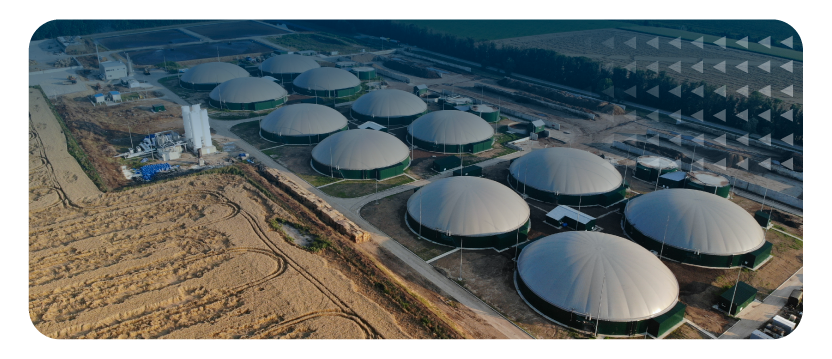
In agriculture, the most widely used biofuel is biogas, produced through anaerobic digestion of organic waste.
Biogas production through anaerobic digestion
The process consists of the biological decomposition of organic matter in the absence of oxygen. Common substrates include:
- Livestock effluents
- Waste from poultry or pig farms
- Agricultural by-products
- Industrial sludge
The result is a gaseous mixture whose composition depends on the substrate and the biological process.
Biogas composition and chromatography analysis
Biogas is typically composed of:
- 50–70% methane (CH₄)
- 30–50% carbon dioxide (CO₂)
Traces of H₂S
Moisture and other minor compounds
To use it in industrial engines, it is necessary to perform chromatography analysis to determine methane percentage, lower calorific value (LHV), presence of hydrogen sulfide, and moisture content. - Traces of H₂S
- Moisture and other minor compounds
To use it in industrial engines, it is necessary to perform chromatography analysis to determine methane percentage, lower calorific value (LHV), presence of hydrogen sulfide, and moisture content.
Calorific value of biogas (kcal/Nm³)
The calorific value of gaseous biofuel depends directly on the methane content:
- Biogas at 55% CH₄ → Approximate LHV: 4,800–5,000 kcal/Nm³
- Higher methane concentration → higher energy per unit of volume
This variability impacts engine performance and system control
Technical challenges of using biogas in industrial engines
Biogas is not a homogeneous fuel like commercial natural gas. Its use requires proper technical control.

Air/gas mixture control in biogas engines
The engine requires a precise air/fuel ratio to avoid power loss, knocking, and overheating. Proper management of this mixture is key to stability and equipment lifespan.
Explore more about gas management.
Speed and load control under biofuel variability
Variations in calorific value directly affect RPM, torque, frequency stability in power generation, and behavior under load. The control system must compensate for these variations in real time.
Engine protection against impurities
H₂S and moisture present in gaseous biofuel can cause corrosion, reduced lifespan, and premature failures. System design must include filtering, monitoring, and protection.
Integration of biogas into agro-industrial energy systems
The implementation of biofuel is not only a matter of fuel. It requires full technical integration.
Conversion of engines to gas or biogas
Engines originally designed for diesel can be adapted to operate with gaseous biofuel, provided that appropriate ignition systems, air/gas mixture control, and operating parameter adjustments are implemented.
Learn more about our gas/biogas engine conversion solution.
A real example is the success case of Servintel and PESA, where work was carried out on a CAT C4.4 engine adapting it to natural gas and biogas, with validation over 2000 hours of operation.
Hybrid management: biogas + grid + solar
In agro-industrial environments, biofuel can be integrated into hybrid schemes combining grid electricity, solar generation, biogas generator, and conventional backup. Coordination between these sources requires proper energy management systems.
Explore our solution for hybrid microgrid management.
System monitoring and supervision
To evaluate real performance, it is necessary to record energy production, consumption, events, and trends. Without measurement, there is no verifiable efficiency.
Do you already know our solution for cloud or on-site monitoring?
Technical advantages of biofuel when properly implemented
When the system is designed from engineering and control, gaseous biofuel allows:
To evaluate real performance, it is necessary to record energy production, consumption, events, and trends. Without measurement, there is no verifiable efficiency.
Do you already know our solution for cloud or on-site monitoring?
Technical advantages of biofuel when properly implemented
When the system is designed from engineering and control, gaseous biofuel allows:
- Use of own organic waste
- Reduction of diesel dependency
- Stabilization of energy costs
- Integration with existing infrastructure
It is not a universal solution. Its viability depends on technical analysis, supply stability, and proper control system design.
Servintel solutions for industrial biofuel management
Understanding what biofuel is implies recognizing that it is not simply renewable energy, but a fuel with physicochemical characteristics that must be properly managed.
In the agro sector, biogas represents a concrete opportunity when addressed from technical analysis, proper control, industrial integration, and continuous supervision. When these elements are combined, biofuel ceases to be a trend and becomes a viable energy solution.
Does your operation work with biogas or is it evaluating its implementation? Contact Servintel for a personalized technical consultation.
In summary
What is biofuel and how is it obtained?
It is a fuel obtained from biomass that releases energy through combustion or thermal conversion.
What is the most used biofuel in agriculture?
In agriculture, the most widely used is biogas, produced through anaerobic digestion of organic waste.
Can biogas be used in a conventional diesel engine?
Not directly. Engine conversion or adaptation is required, along with appropriate mixture control and ignition systems to operate with gaseous biofuel.
It is a fuel obtained from biomass that releases energy through combustion or thermal conversion.
What is the most used biofuel in agriculture?
In agriculture, the most widely used is biogas, produced through anaerobic digestion of organic waste.
Can biogas be used in a conventional diesel engine?
Not directly. Engine conversion or adaptation is required, along with appropriate mixture control and ignition systems to operate with gaseous biofuel.
What problems can biofuel cause if not properly controlled?
A poorly managed gaseous biofuel can cause knocking, overheating, RPM instability, corrosion from H₂S, and reduced lifespan. Technical gas management is essential.
Can biogas be integrated into a hybrid microgrid?
Yes. It can be coordinated with the electrical grid and solar generation through energy management systems that prioritize sources and stabilize operation.